

16.02.2023.
Zadar's Teatro Verdi: the Glory and Fall of the Largest Theatre in Dalmatia
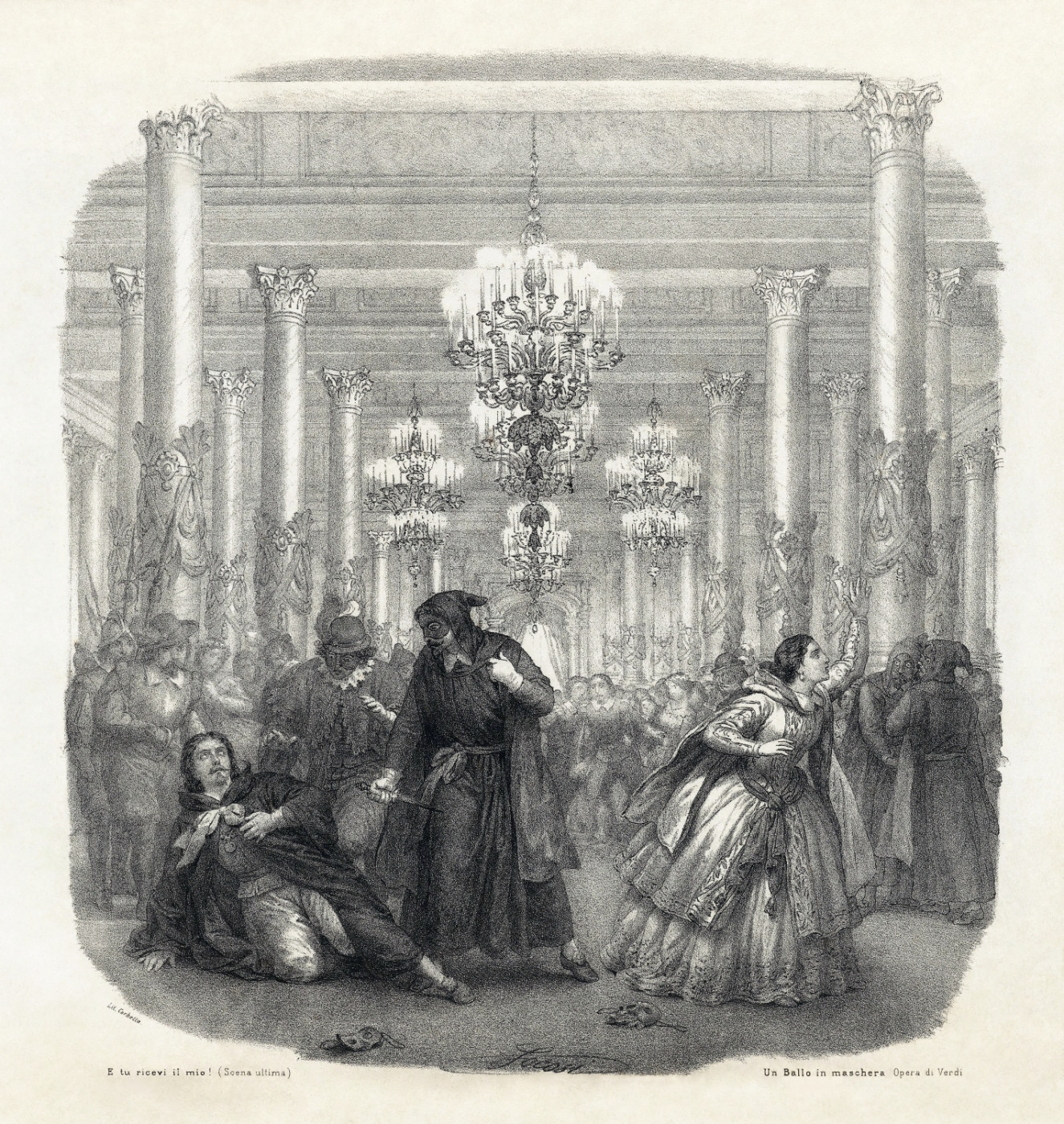
The first Zadar theatre building, Teatro Nobile or Noble Theatre, was built as early as 1783, on the site of today's Croatian National Theatre in the city centre, at a time when the Venetian Republic (Serenissima Repubblica di Venezia) was on the decline. The future Verdi theatre building was built as the Teatro Nuovo (New Theatre) and opened on 7th October 1865 with the performance of Giuseppe Verdi's opera A Masked Ball (Un Ballo in maschera), reflecting the magnificence, splendour, wealth and political power of Zadar of the time, as the capital of Austrian Dalmatia.
At the same time, with its construction, North Italian Historicism arrived in Zadar with reminiscences of the Renaissance and Classicism. The initiators of its construction were Dr Šimun Katić, Dr Anton Stermić (Antonio de Stermich) and the President of the Commission Dr Natale Filippi, who, in 1863, bought the building of the Lantana family on the Square of Our Lady of the Castle (Trg Gospe od Kaštela). The demolition of that building resulted in an irregular rectangular space flanking the military estate at the Three Wells Square (Trg tri bunara), the Chain Gate and the Park of Our Lady of Health, while the inner irregular side, with the gardens and unbuilt terrain, extended to the Cathedral of St Anastasia.
A view of the theatre boxes and the elegant splendour of Zadar’s Teatro Verdi
The first sketch of the facade of the future theatre was made by the architect Dr Enrico Trevisanato (who previously made the Teatro dell'Armonio in Trieste), but the changes with corrections to the boxes, facade, hall and galleries are the work of Dr Filippi. In the end, the theatre was really luxurious: it could accommodate as many as 1,500 spectators at the time when the city had between seven and ten thousand souls at most, and it had three halls – the theatre, concert and dance hall - while the interior furnishing was done by masters from Venice and Vienna. The construction began in 1864 with the intention of being the most beautiful and impressive theatre in Dalmatia, even more representative than the Bajamonti Theatre in Split or the new Bond Theatre that was being built in Dubrovnik at the same time. The supervisor of the works was the engineer Mihovil Klaić; the internal construction of the boxes was executed by the carpenter Frane Fabrović (Francesco Fabrovich), and Carlo Franco was hired to decorate the ceiling of the entire theatre and stage. The architrave, pilaster and frieze of the stage were also his work, as well as perforated iron lanterns for lamps and the fabric lining of all 75 theatre boxes, the decoration of the imperial box and other gilding works. The painting was entrusted to the Venetian painters Antonio Zuccaro and Carl Matesheg, so the Victory of Civilization was painted on the ceiling. The length of the building along the longitudinal axis was 44.5 metres, the width of the lodges 11 metres, and the height 9 metres with a stage depth of 10 metres, while the elegant concert hall - which hosted philharmonic concerts up to eight times a year - could accommodate 400 people. It also had specially made parquets, two large chandeliers and three huge mirrors. The theatre was finally ceremonially opened on 7th October 1865 as Teatro Nuovo, although a little earlier, on 10th September, it was also open for the farewell party of the Governor Baron Lazarus Mamula.
Street view of the theatre in 1903 (on the left)
Decades later, the Zadar theatre was the centre of the city's cultural and artistic life, and it hosted operas, operettas, ballets, comedies, dramas, silent and sound films, dances and balls. Some of the biggest acting and music stars performed in Zadar: silent film star and theatre actress Alda Borelli, actor Ferruccio Benini, the greatest theatre actress of her time Eleonora Duse called Divina, actor Alfredo de Sanctis, and many others.
Lithograph of “A Masked Ball”, Verdi's opera with which the Zadar theatre was ceremonially opened
In 1901, the Zadar theatre was renamed Teatro Verdi after the famous composer Giuseppe Verdi and probably due to the changed political situation in Zadar, which was the only city at the beginning of the 20th century ruled by the Italian autonomists. Even though Zadar was assigned to the Kingdom of Italy only after the First World War, a period of becoming less important and quiet decline began for Teatro Verdi. The competition of cinematography became a serious threat to theatrical activities, and when in 1924 the Zadar entrepreneur Aldo Meštrović built the Teatro Nazionale on the remains of Teatro Nobile, the most modern and best-equipped building for 800 people, which mostly aspired to satisfy the taste of the audience, the story with Verdi’s theatre started going towards its end relentlessly.
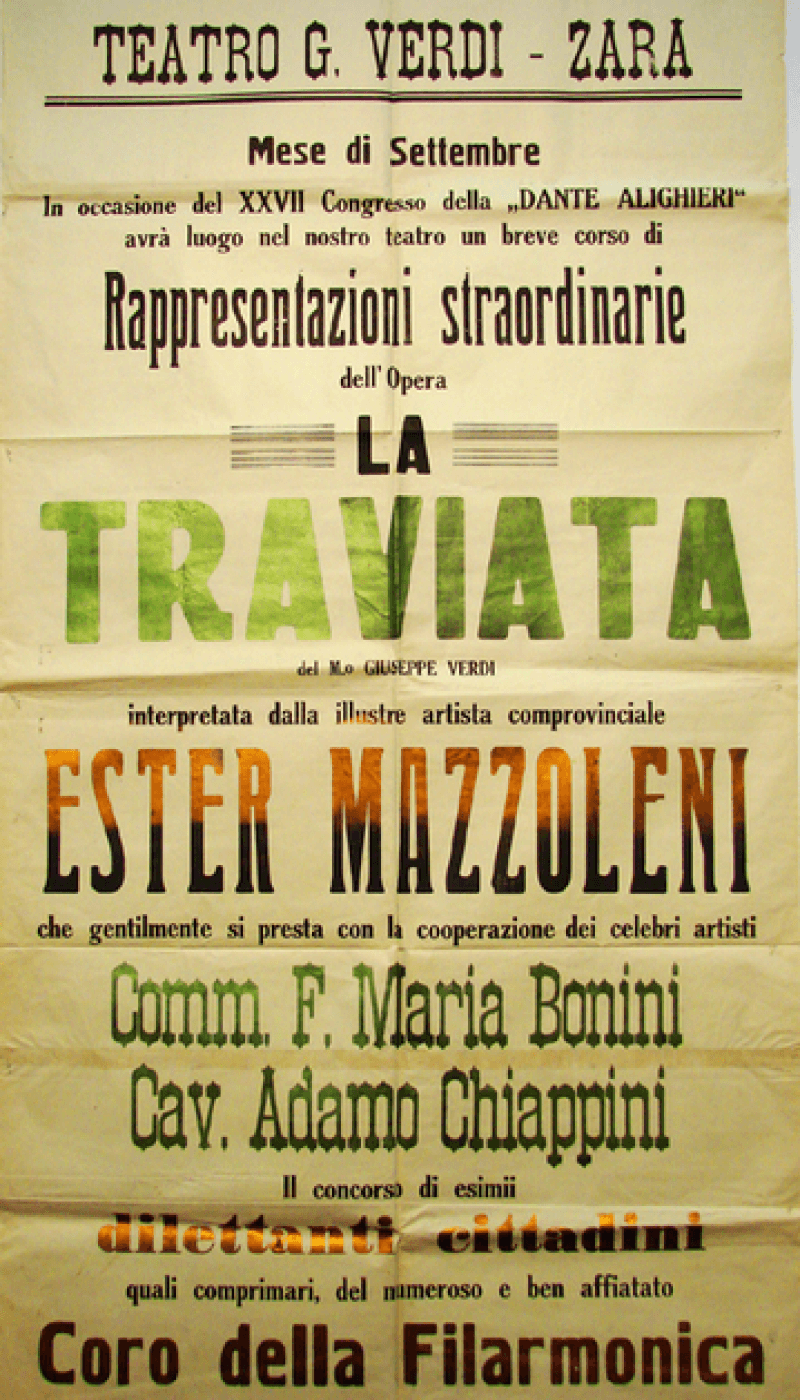
La Traviata poster performed at Teatro Verdi
During the Allied bombing of Zadar in the Second World War during December of 1943 and February of 1944, the building of this most beautiful and largest theatre on the east coast of the Adriatic, was badly damaged. One of the bombs dropped on the city, which was then under the Italian and German occupation, caused a crack of three to four metres on the roof, so although the perimeter walls, facade, most of the interior and the magnificent theatre boxes withstood the bombing, the fate of the theatre, which once hosted Europe’s biggest singing, music and acting stars, was sealed. After the liberation of the city, the Yugoslav authorities did not show excessive sensitivity for the Italian cultural heritage in Zadar, so the damaged theatre was left to deteriorate. Requests for its restoration were rejected, and it was not long before it was ordered to use the supporting beams of the Teatro Verdi for the construction of a bridge near the town of Karin in the Zadar hinterland. The former renowned Zadar theatre was completely razed to the ground, and in its place, exactly 100 years after its opening in 1865, a new building was erected.
Damages to Teatro Verdi caused by the Allied bombing
Voir la vidéo
.
Veux-tu savoir plus?
Propositions