
29.03.2021.
Luxurious Zadar Wedding from the 15th Century
During its long and ancient past, Zadar was not only the target of conquerors and plunderers, merchants and benefactors, but also of Medieval pilgrims who gladly visited one of the largest and most important cities on the eastern Adriatic coast on their way to the Holy Land. One of them was the knight Konrad Grünenberg (also known as Conrad Grünenberg and Konrad von Grünenberg), a prominent citizen of Constance, a town in the present-day state of Baden-Württemberg and the largest settlement on Lake Constance and the centre of Constance District.
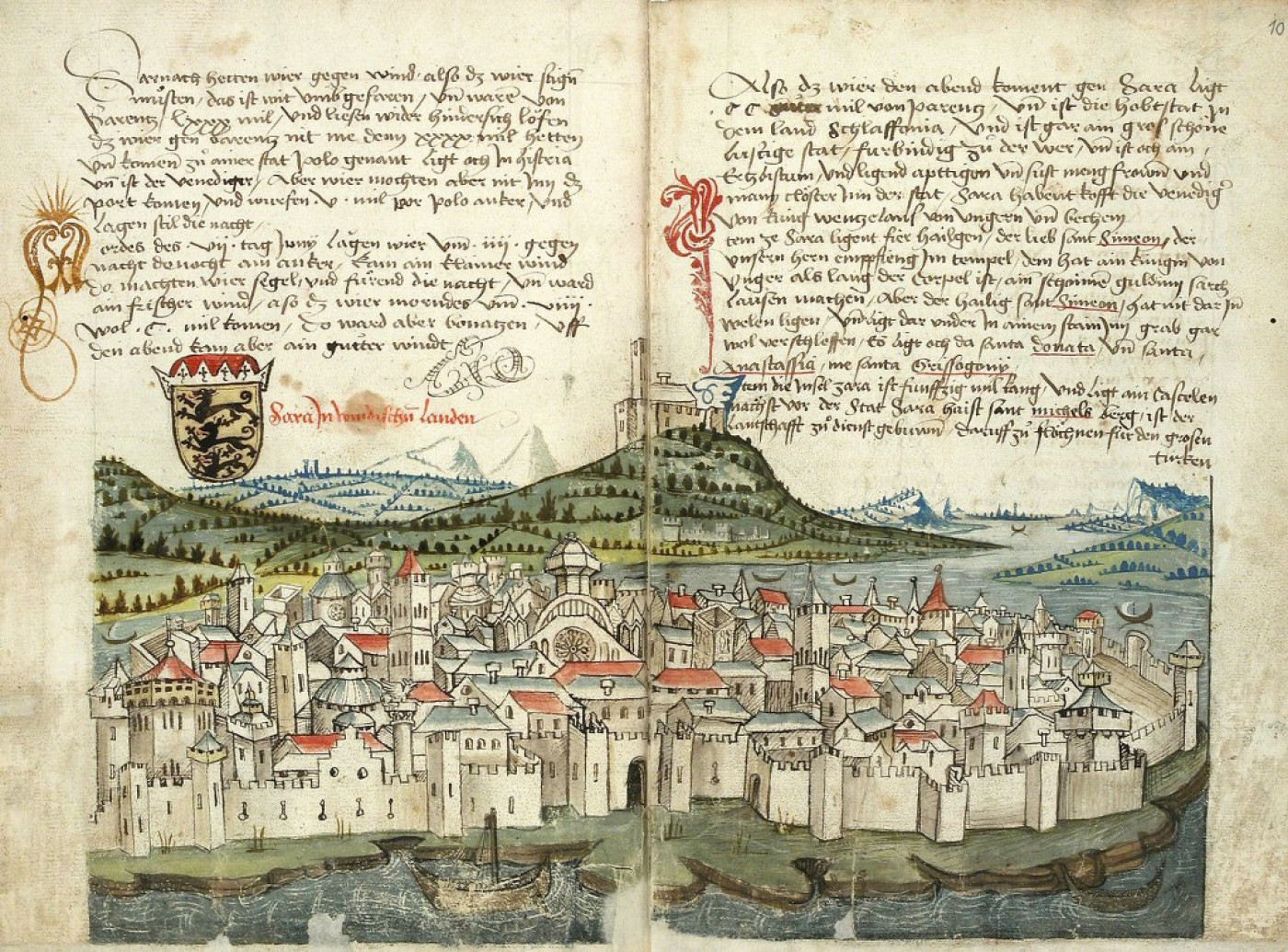
Passing through the cities on the Adriatic Sea from Venice in the north, then Poreč, Šibenik, Hvar, Korčula and Dubrovnik, to Heraklion on Crete, the island of Rhodes and finally Jerusalem in the Holy Land, at the very crossroads from the Mediterranean Sea and Tel Aviv towards the Dead Sea and Jericho, the German travel writer illustrated and described all the cities where he had resided.
According to Grünenberg, Zadar is “a rather large and attractive city with excellent fortifications”. The year was 1486, approximately eight decades after the sale of Zadar to Venice and the dynastic rights of King Ladislaus of Naples (Ladislao I di Napoli) to Dalmatia for 100,000 ducats. At that time, Zadar was still the administrative centre of Dalmatia, but under the rule of the Venetian Republic, which gradually spread over the entire Dalmatian area, except for the territory of the Republic of Ragusa (Dubrovnik).
Konrad Grünenberg: Description of a Pilgrimage from Konstanz to Jerusalem, Cod. St. Peter pap. 32
Despite the obstruction, persecution and confiscation of property of the Zadar nobility who opposed the Venetians, in Konrad's illustrations we see a powerful city, and in its descriptions a very rich domicile Slavic population. Thus, in the extensive description of his stay in Zadar, the German illustrator and writer noted with his full attention a spectacular wedding procession, which reveals the still existing and lavish customs of the Slavs. Konrad writes: “Furthermore, we saw a wedding procession in Zadar. The women wore all sorts of ribbon and clothing ornaments. The bride wore a beautiful golden crown with precious stones on her head, and a wreath on top of it. When she reached the end of one alley, at the beginning of the other, she stopped and bowed to the crowd watching the procession. Then the bride began to be sprinkled with grain, oats, spelt, barley and all kinds of grain from the surrounding houses. This was repeated in all the streets to the church, as well as on the way back from the church. We inquired with our landlady about the meaning of that sprinkling and throwing of grain, and what that meant; and she told us that this was done to bring happiness to the bride and her future children, and to such an extent that they never run out of grain, but on the contrary, that they always have everything in abundance. Insatiable in the desire to see all these strange foreign customs, we took the opportunity to join the procession. When we came to the church, we attended a mass that was arranged according to the Slavic rite. The way the priest performed God's service, his gestures and movements, were very unusual, and this also applied to the worshippers. Before the sacrament of Sacrifice, the priest turned to the people holding the cross, and all the men came to kiss the cross. Then he took in his hand a plate with the image of Our Lady, and all the women came to kiss her. Everyone in the church held a burning candle in their hands until the Mass was over."
Celestin Medović: Coronation of Ladislaus of Naples in 1403, who later sold Zadar to the Venetian Republic
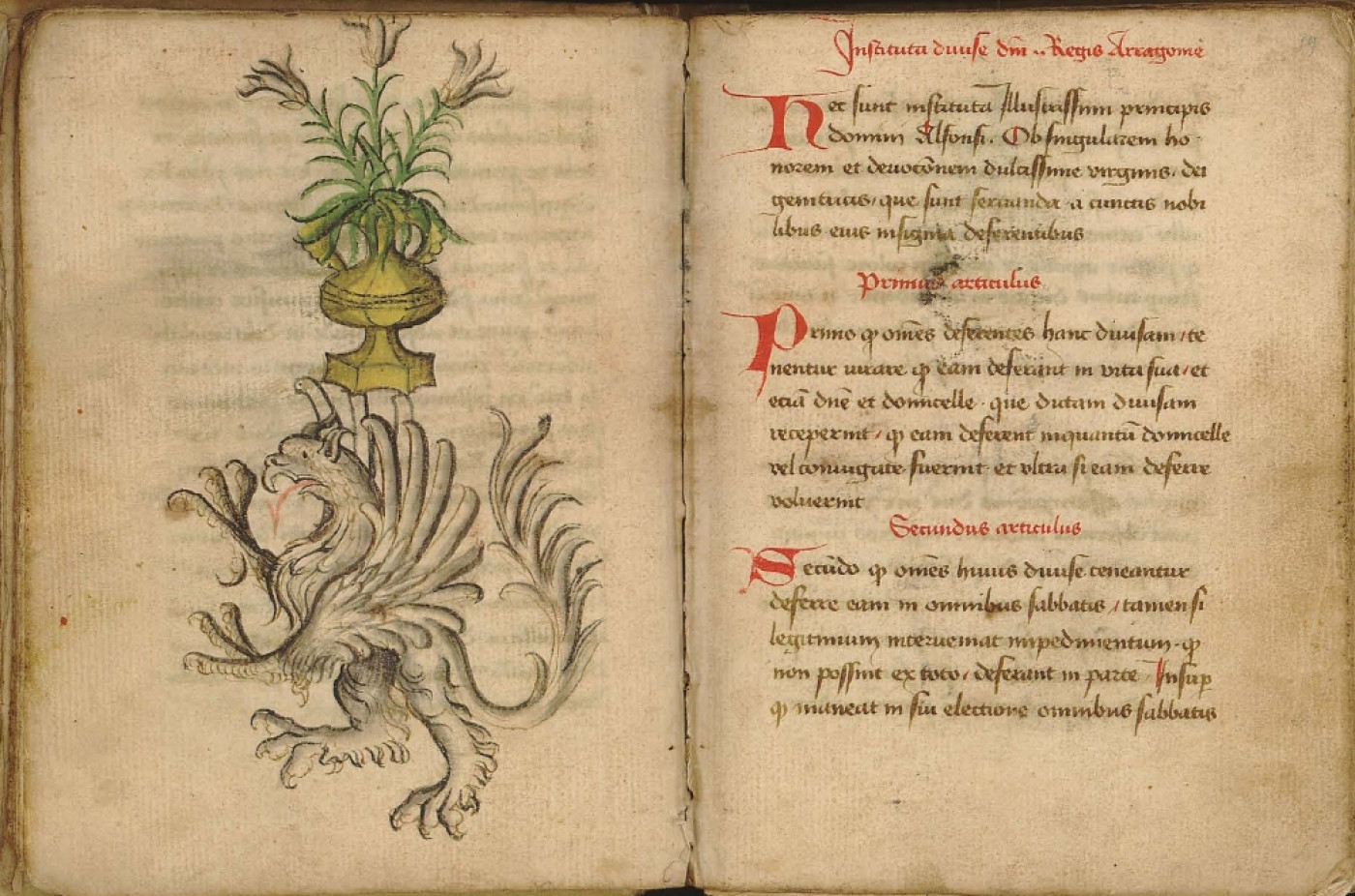
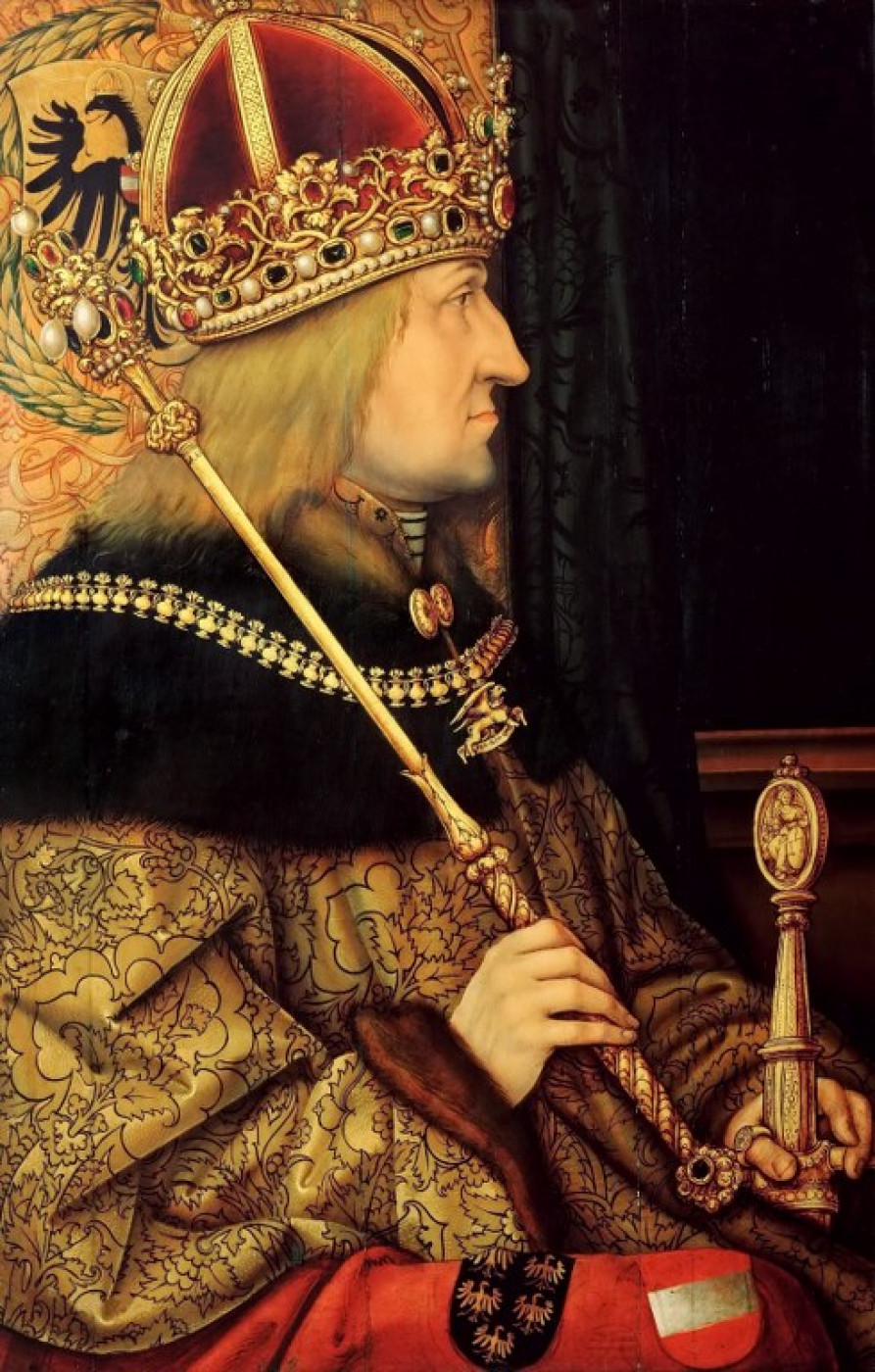
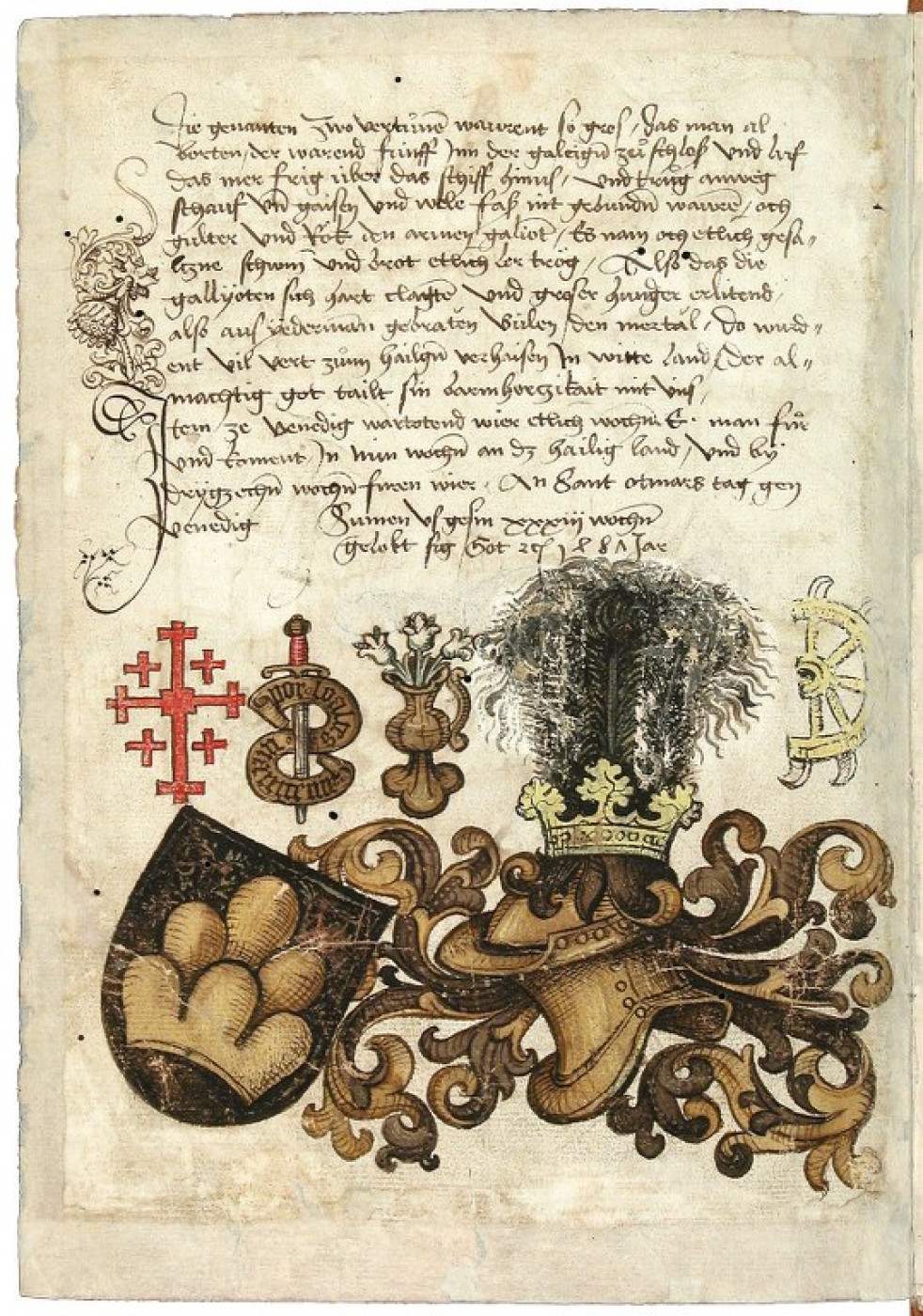
The writer of these lines, Grünenberg, was a resident of Constance who was mostly engaged in heraldry, so in addition to his illustrated travelogue, he is also known as the author of a 1483 chronicle containing coats of arms (Österreichische Wapperchronik). Grünenberg was first mentioned in documents from 1441 as a judge and church architect. Until 1465 he was in the service of Frederick III (Friedrich III), Emperor of the Holy Roman Empire, Austrian Archduke and German King of the Habsburg Dynasty. No later than 1486, Grünenberg acquired the status of Ritter (knight), while in Jerusalem he most likely became a Knight of the Holy Sepulchre in Jerusalem. He was also a member of the Aragonese Knights Orden de la Jarra de la Salutación (Order of the Jar) and the Austrian Order of St George. Work on his illustrated travelogue began with a journey that started on 22nd April 1486 in Constance and lasted a total of 33 weeks, and he returned to his hometown in December of the same year.
Grünenberg's text about Zadar and illustration of a city in ruins
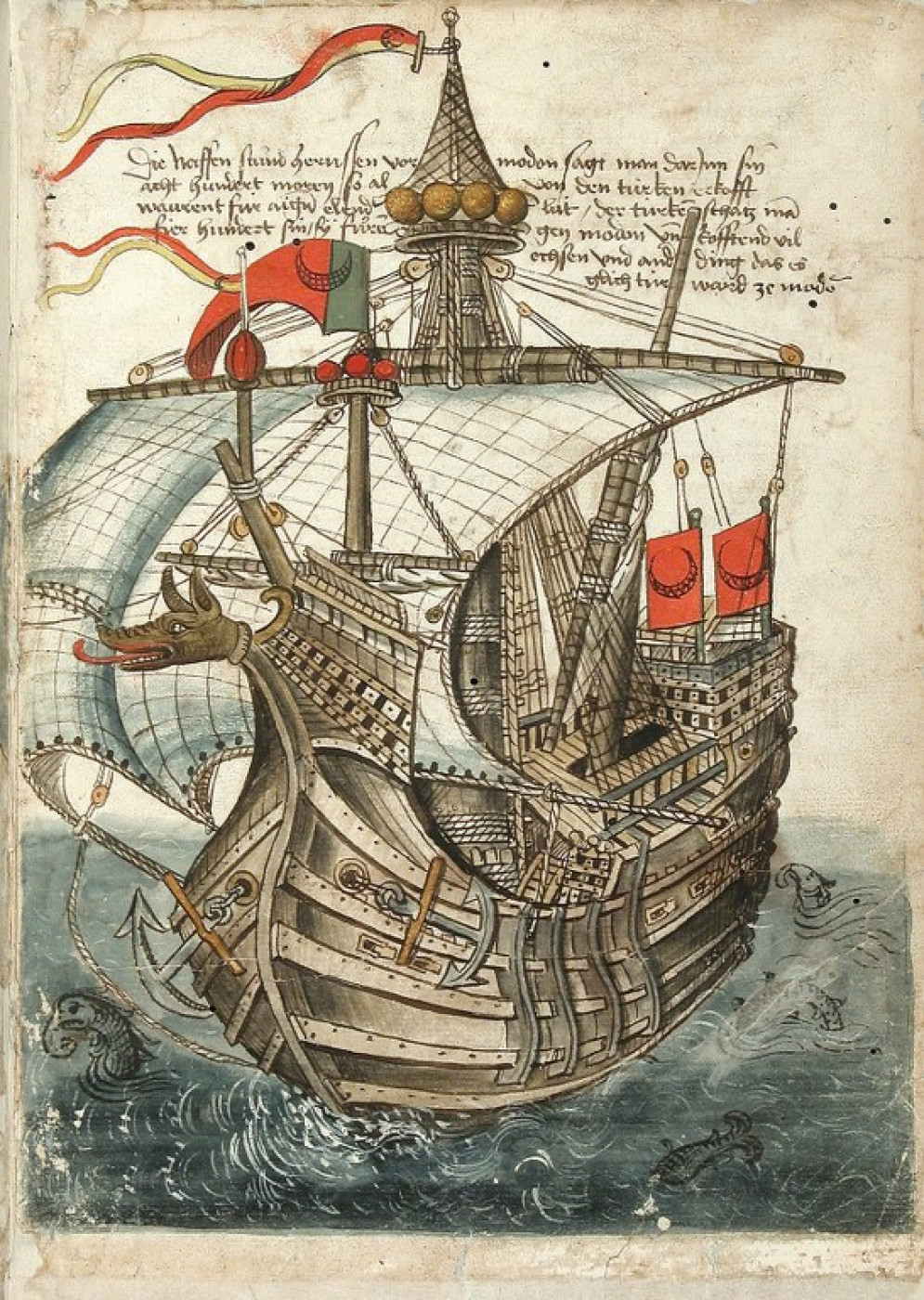
Konrad set out for Venice from Constance via Rheineck and Sterzing in Tyrol, and on 31st May he sailed in a galley from Venice, visiting Poreč, Zadar, Šibenik, the town of Hvar (then called Lesina), the town of Korčula, Dubrovnik (Ragusa), Corfu, Methoni (Modon) in Morea (Peloponnese), Heraklion (Candia) in Crete, Rhodes, Famagusta in Cyprus and Jaffa (Hebrew Yafo, now annexed to Tel Aviv) where he arrived on 24th July. Travelling further on a donkey, he visited Lod (Lida, Lydda), Ramle, Emmaus (Imwas), Jerusalem and Bethlehem. He was in Jaffa again on 1st September, from where he returned to Venice by a ship on 16th November. Returning to Constance in early December 1486, he soon completed the two earliest manuscripts on the pilgrimage. Manuscripts from 1487 are considered to be autographs; the older is kept in the Baden State Library (Badische Landesbibliothek) in Karlsruhe as Cod. St. Peter pap. 32, while the second, more detailed one is kept at the Gotha Research Centre of the University of Erfurt. Both codices contain colour drawings, so although some drawings in the Karlsruhe codex appear to had been made by Grünenberg himself, the Gotha Centre codex was illustrated by slightly larger drawings, which combine features of Karlsruhe drawings with features borrowed from a Dutch woodcutter, artist and publisher, Erhard Reuwich, also a pilgrim to the Holy Land. In general, the Karlsruhe manuscript was interpreted as Grünenberg's private copy, while the Gotha manuscript, with a more elaborate text and more detailed drawings, was interpreted as a presentation copy dedicated to an important figure.
Voir la vidéo
.
Veux-tu savoir plus?
Propositions

Evènements
Exhibition Of The Most Controversial Artist In The World | Zadar Does Banksy
06.06.2023.

Gastronomie
Brudet Cooked in a Lopiž With a Taste of the Historical Glory of Iž Pottery
17.07.2024.

History, Sport
God Created Man; Zadar Created Basketball, Part 2
29.06.2021.

Gastronomie, History
Maraschino was Enjoyed by the Elite, and Zadar's Vlahovac by the Entire World
16.01.2024.